
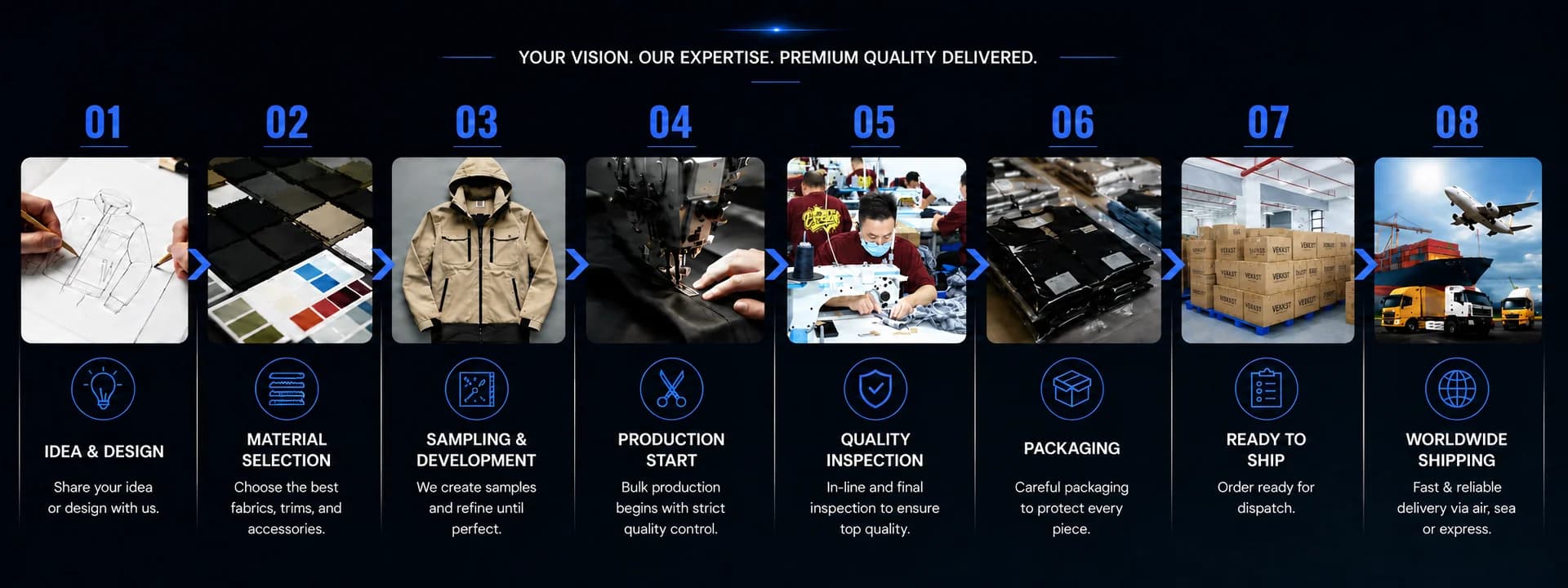
For a first streetwear drop in 2026, a realistic budget is $2,000 to $5,000. That covers a production-ready tech pack, one round of custom samples, a 60-100 piece bulk run, and international shipping — with enough left over to actually market the drop. Brands that launch for less usually skip the sample or cut quality; brands that spend more are usually over-customizing too early.
The range is wide because three decisions move the number more than anything else: how many pieces you order, how custom your fabric and trims are, and whether your first sample is right the first time. Below is where the money actually goes, five ways to stretch a small budget, and the four mistakes that most often kill a first drop.
1. The Short Answer: $2,000-$5,000 for a First Drop
Broken down, a typical first drop looks like this: a tech pack ($0-$300 — free if your factory helps finalize it), one custom sample ($50-$150, usually 2-3x the bulk unit price), a bulk run of 60-100 hoodies at $8-15 per piece ($600-$1,500), express sample shipping plus bulk freight ($300-$600), and labels, tags and packaging ($100-$250). That lands most startups between $2,000 and $3,500 before marketing.
What pushes you toward the top of the range: custom-dyed fabric, complex prints or embroidery on multiple placements, and ordering several styles at once. What keeps you at the bottom: one hero product, factory stock fabrics, and a tech pack complete enough that the first sample is the only sample you need.
2. Where the Money Actually Goes
Five cost centers eat a startup budget. The tech pack is your blueprint — measurements, fabric weight, artwork files, label specs — and factories quote 2-3x more accurately when they have one. Sampling costs 2-3x the bulk unit price because pattern-making and machine setup cannot be spread across a run. Bulk production is the big line item, driven by fabric and quantity. Freight covers samples by DHL or FedEx (3-5 days, $30-$80) and the bulk order by air or sea. Finally, woven labels, hang tags and custom packaging add $1-2 per piece if you go fully custom.
The hidden costs are the ones that hurt: a second or third sample round because the tech pack was vague, re-print charges when artwork files were wrong, and import duties on arrival (check your country's de minimis and duty rates for apparel before you price your drop). Budget a 10-15% buffer for these, and they become annoyances instead of emergencies.
3. Five Ways to Stretch a Small Budget
A small budget does not mean a weak launch — it means a focused one. These five moves consistently save first-time founders the most money:
- 1.Launch one hero product, not a collection — one great hoodie outsells five mediocre styles and keeps your MOQ, sampling and photography costs to a single item.
- 2.Choose factory stock fabrics instead of custom-dyed rolls — custom dyeing carries roll minimums and surcharges; a good stock 400-500gsm fleece looks identical to your customers.
- 3.Use FPP (full-package production) — the factory bundles fabric sourcing, trims and labels into one quote, so you avoid separate agent fees and minimums on every component.
- 4.Get the first sample right — a complete tech pack with measurements, artwork placements and reference photos costs you a few hours and saves entire re-sampling rounds at $100+ each.
- 5.Split the drop, not the budget — produce 60-100 pieces now, then reorder with the same pattern; setup costs are paid once and your second run is cheaper per piece.
4. Budget Mistakes That Kill First Drops
Most failed first drops were not bad designs — they were bad budget allocation. Walk away from these four traps:
- ✗Spending 100% on inventory — a great product with zero marketing budget sells nothing; keep 20-30% of your total budget for content, ads and photography.
- ✗Skipping the paid sample to save $100 — you are then gambling $1,500 of bulk money on a factory you have never verified.
- ✗Custom everything on drop one — custom-dyed fabric, custom zippers, custom woven labels each carry their own MOQ surcharges; go custom on the one detail customers actually touch, standard on the rest.
- ✗Forgetting freight and duties — air freight on 100 hoodies runs $300-$500 and apparel duties vary by country; price your drop with shipping included or your margins vanish.
5. Sampling Costs and Payment Terms, Explained
Expect to pay 2-3x the bulk unit price for a custom sample — typically $50-$150 for a hoodie — because one-off pattern work and setup cannot be amortized. Serious factories credit the sample fee against your bulk invoice, so sampling is effectively free when you proceed. Samples ship by DHL, FedEx or UPS and arrive in 3-5 business days with customs handled by the courier.
The industry-standard payment structure is a 30% deposit to start production and 70% balance after you review photos and videos of the finished, packed goods. A factory that demands 100% upfront to a personal account, with no platform protection or contract, is a red flag — walk away. The 30/70 structure keeps leverage on your side until you can see what you are paying for.
6. How Vekkst Works With Startup Budgets
Vekkst is an OEM/ODM streetwear manufacturer in Dongguan, China, and most of our client relationships start exactly at this stage. Our MOQ is 60-100 pieces per style — genuinely cut and sewn to your tech pack, not printed blanks — produced under the same ISO 9001-certified process and three-stage inspection as our bulk orders. Samples ship in 3-7 days; bulk production runs 15-25 days depending on complexity.
Every quote we send is itemized — pattern work, sampling, unit price, and freight listed separately — so you can see exactly where each dollar goes before you commit. Sample fees are credited against your bulk order, and our team flags budget traps in your tech pack (custom components that add cost without adding value) before they hit your invoice.
7. Frequently Asked Questions
Can I start a clothing brand with $1,000?
Yes, but it is tight. One product, stock fabrics, a 30-60 piece run from a sampling studio or flexible factory, and your own photography. Expect most of the $1,000 to go to the sample and micro-run, leaving little for marketing — plan your content before the goods arrive.
How much does a tech pack cost?
Freelance tech pack designers charge $50-$300 per style. Many factories, including Vekkst, will help finalize your tech pack free of charge when you produce with them — measurements, fabric weight, artwork files and label specs are all they need to start.
How much does one custom hoodie cost at low MOQ?
Roughly $8-15 per piece at 60-100 pieces, depending on fabric weight (GSM), print method and embroidery. At 500+ pieces the same hoodie usually drops several dollars per piece because setup costs spread across the run.
What are standard payment terms with clothing factories?
A 30% deposit to begin production and 70% balance after you approve photos and videos of the finished, packed goods. Never pay 100% upfront to an unverified account — the deposit structure protects both sides.
How much of my budget should go to marketing?
At least 20-30%. The most common first-drop failure is a great product and an empty marketing budget. Content shot before the goods arrive — factory videos, sample unboxings, behind-the-scenes — costs almost nothing and builds the audience you will sell to.
The Bottom Line
You do not need $20,000 to start a clothing brand in 2026 — you need $2,000 to $5,000, one hero product, a factory that works at startup quantities, and the discipline to keep 20-30% of the budget for marketing. Spend on the sample, verify before bulk, and let the second drop fund the third.
Ready to go deeper? Learn how to find factories that work at 60-100 piece MOQs, read our complete OEM manufacturing guide, browse our streetwear products for fabric and customization options, or request a quote with your tech pack for an itemized startup budget.
Get an Itemized Quote for Your First Drop
Send us your tech pack or even a rough idea — we will break down sampling, unit costs and freight so you know your real budget before you spend anything.